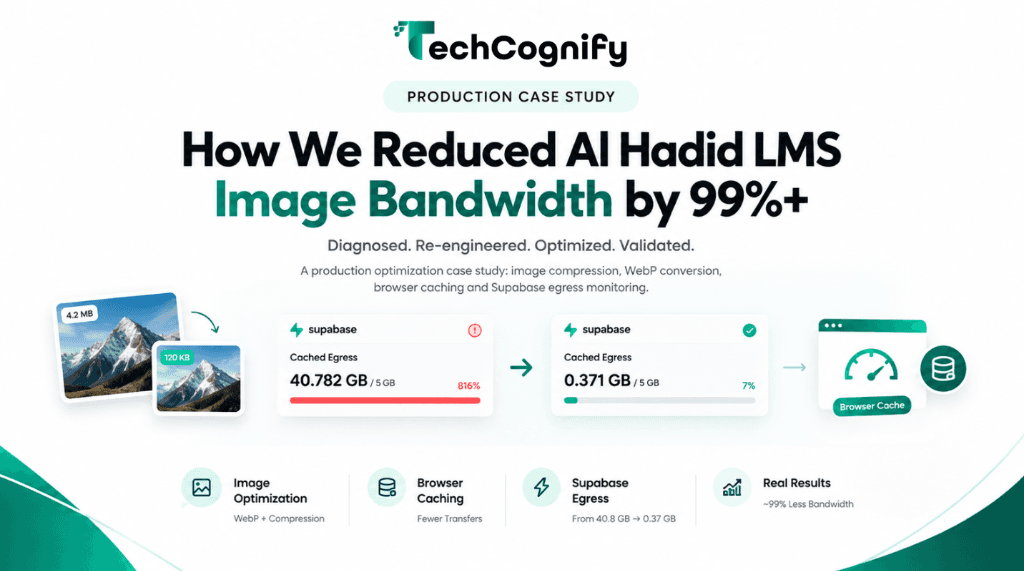
Before: Monthly Egress
816% of 5 GB Plan Quota
After: Monthly Egress
7% of 5 GB Plan Quota
Executive Brief: How TechCognify diagnosed excessive cloud storage bandwidth on Al Hadid LMS and re-engineered the delivery pipeline—eliminating unnecessary infrastructure bills without forcing account upgrades.
The Problem Wasn't the Application. It Was the Way It Delivered Data.
Al Hadid LMS was already running smoothly in production. Students were actively logging into their courses, administrators were updating educational content, and the core application functionality met every user expectation.
However, continuous infrastructure telemetry revealed a critical issue behind the scenes:
Supabase cached egress had surged to approximately 40.8 GB against a 5 GB plan quota — exceeding plan limits by over 800%.
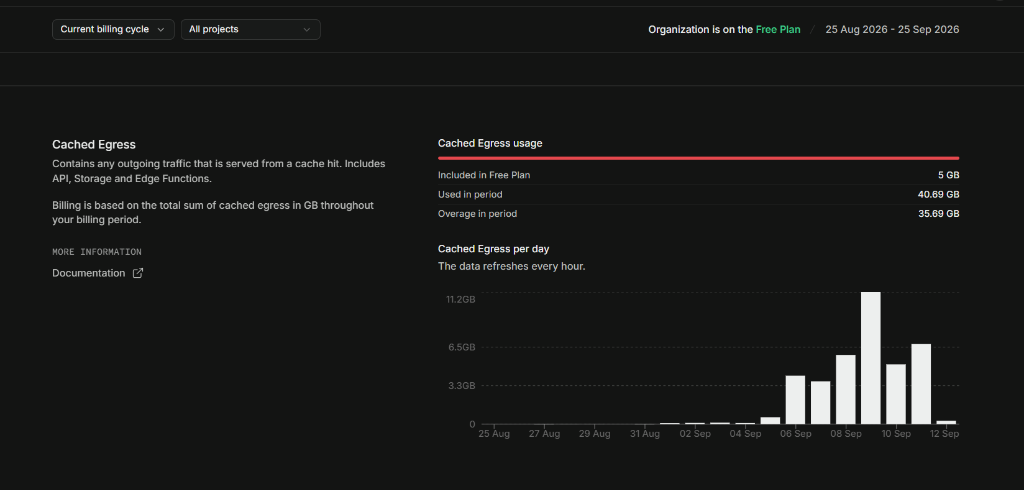
This wasn't a functional software bug. It was a production infrastructure efficiency issue.
When cloud usage spikes, many teams take the easy path: click "Upgrade Plan", pay higher recurring monthly invoices, and move on. At TechCognify, we don't believe in masking architectural flaws with bigger infrastructure budgets.
Instead of asking our client to pay more for cloud bandwidth every month, we asked a fundamental engineering question: Why is the system consuming so much data in the first place?
We Traced the Data Delivery Path
We conducted a root-cause telemetry audit, inspecting how media assets were uploaded, stored, queried, and transmitted across the network to end users.
The audit highlighted a major inefficiency in image delivery.
[Raw User Upload] ➔ [Cloud Storage] ➔ [Uncompressed Transfer] ➔ [End User Device]
   (Heavy 4MB-10MB Assets Multiplied Across Thousands of Daily Student Requests)
Several course images were vastly larger in file size and dimensions than necessary for their actual UI containers. Every single unnecessary megabyte was multiplied exponentially across active users, page views, course refreshes, and mobile sessions.
The issue was not that Supabase Storage couldn't scale to handle the traffic. The issue was that the application was forcing the infrastructure to deliver far more payload than necessary.
That distinction separates standard development from true production engineering.
We Rebuilt the Image Delivery Pipeline
Rather than serving stored assets directly in their raw, original state, we re-engineered the asset lifecycle by integrating an automated server-side image processing layer powered by Sharp.
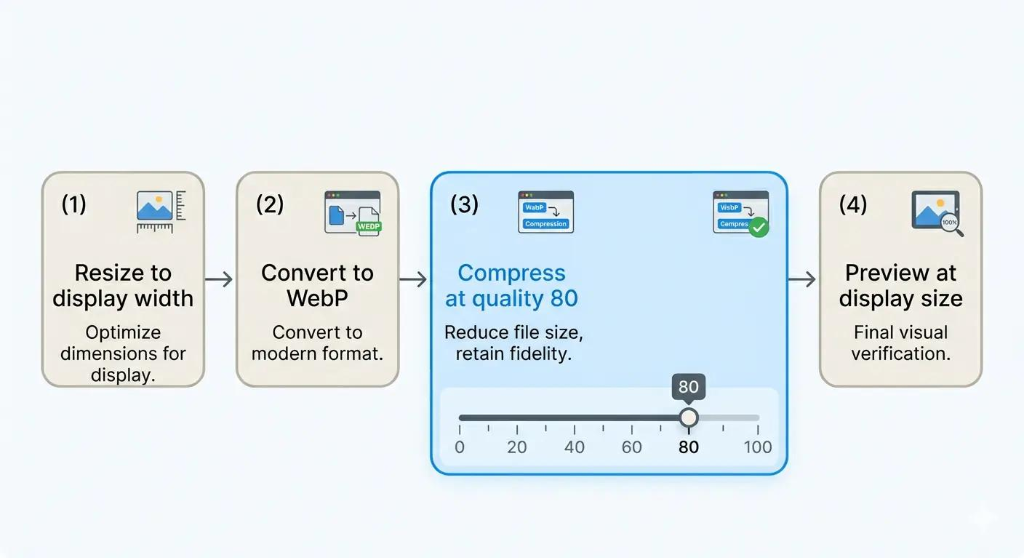
Our optimization strategy targeted three core metrics:
- Dimension Resizing: Standardizing assets to exact max-width display containers (preventing 4000px images from loading in 400px cards).
- Quality-Lossless Compression: Applying precision compression at quality 80, stripping metadata while preserving visual clarity.
- Format Modernization: Converting legacy JPEG/PNG files into modern, lightweight WebP formats.
The objective was clear: transform heavy media delivery into a lightweight, lightning-fast experience.
We Eliminated Unnecessary Repeat Transfers
Optimizing image file sizes solved half of the equation. However, even lightweight files compound into high bandwidth if users continuously re-download them on every page navigation.
We audited the browser caching policy and HTTP headers:
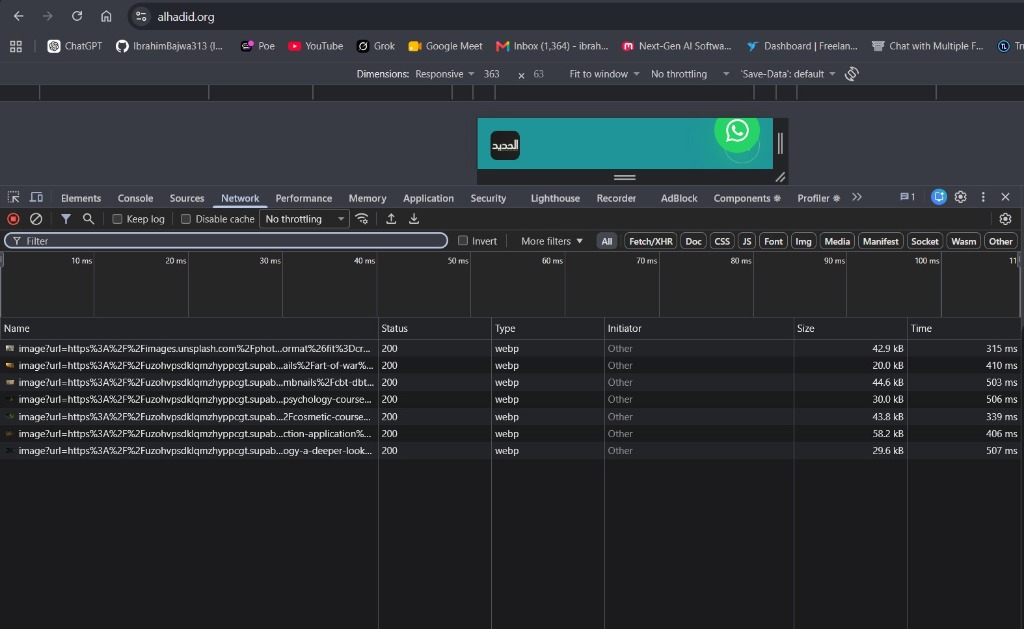
By tuning edge cache controls and browser cache headers, we ensured that:
- If a student's browser already possessed a valid, cached copy of a course graphic, no new network request was triggered.
- Subsequent page visits pulled directly from local disk memory.
This established a Dual-Layer Efficiency Framework:
The Strategic Engineering Decision
When cloud resource usage threatens to breach limits, engineering leadership faces two contrasting strategies:
Increase Infrastructure Limits
- × Upgrade to higher pricing tiers immediately.
- × Pay higher recurring monthly infrastructure fees.
- × Leaves underlying wasteful network architecture unresolved.
<!-- Approach 02: TechCognify Way -->
<div class="relative rounded-xl border border-emerald-500/40 bg-emerald-500/[0.06] p-6 shadow-md shadow-emerald-500/5 transition-all dark:bg-emerald-950/30 dark:shadow-emerald-950/20">
  <div class="mb-3 inline-block rounded border border-emerald-500/40 bg-emerald-500/10 px-2.5 py-0.5 font-mono text-[10px] font-semibold uppercase tracking-widest text-emerald-700 dark:text-emerald-400">
    Approach 02 — The TechCognify Way
  </div>
  <h4 class="mb-2 text-lg font-bold text-[var(--text-primary)]">Fix the Delivery Architecture</h4>
  <ul class="space-y-2.5 text-xs text-[var(--text-secondary)]">
    <li class="flex items-start gap-2">
      <span class="font-bold text-emerald-600 dark:text-emerald-400">✓</span>
      <span>Re-engineer asset pipelines using automated Sharp optimization.</span>
    </li>
    <li class="flex items-start gap-2">
      <span class="font-bold text-emerald-600 dark:text-emerald-400">✓</span>
      <span>Eliminate redundant data transfers with smart caching strategies.</span>
    </li>
    <li class="flex items-start gap-2">
      <span class="font-bold text-emerald-600 dark:text-emerald-400">✓</span>
      <span>Protect long-term operating margins without increasing cloud bills.</span>
    </li>
  </ul>
</div>
We selected Approach 02. Production engineering isn't about blindly adding cloud hardware whenever something gets expensive—it's about understanding and optimizing resource utilization.
Infrastructure Metrics & Measured Results
Following deployment of the Sharp pipeline and updated caching strategy, we monitored Supabase telemetry over subsequent billing periods.
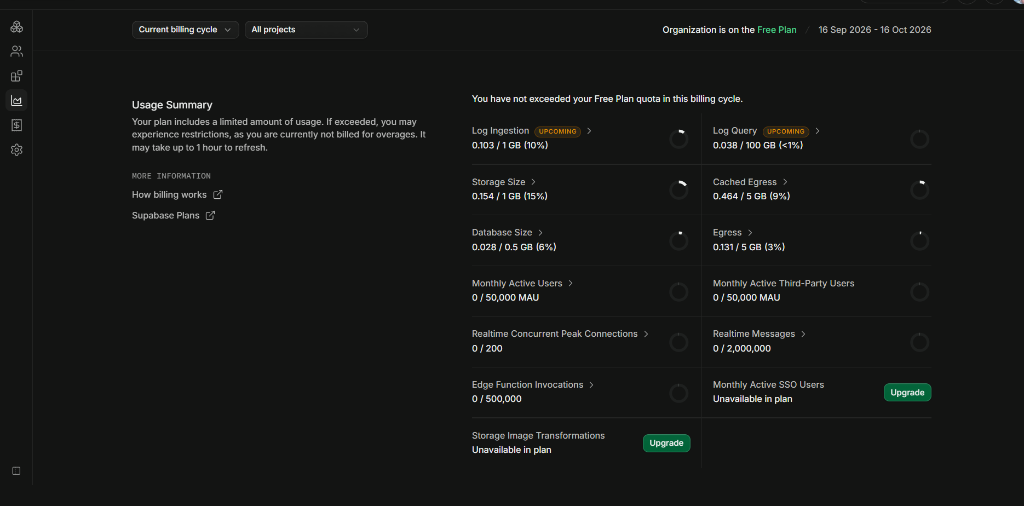
Performance Metric Comparison
| Observed Metric | Baseline (Pre-Optimization) | Validated (Post-Optimization) | Efficiency Variance |
|---|---|---|---|
| Monthly Cached Egress | ~40.78 GB | ~0.37 GB | ↓ 99.1% Reduction |
| Monthly Plan Quota | 5.00 GB | 5.00 GB | 0% Budget Increase |
| Quota Utilization | ~816% (Overage) | ~7% (Healthy) | Fully Restored |
What TechCognify Actually Executed
- • Integrated Sharp image processing
- • Automated WebP format conversion
- • Enforced maximum resolution limits
- • Compressed payloads at Quality 80
- • Enforced HTTP browser cache rules
- • Reduced duplicate image downloads
- • Decreased edge request frequency
- • Accelerated client load times
- • Monitored Supabase egress trends
- • Eliminated recurring overage costs
- • Optimized client application layer
- • Avoided forced plan upgrades
The Bigger Engineering Mindset
This project wasn't just about compressing images. It was about production system governance.
A digital product can look perfect on the surface while quietly bleeding money through unoptimized infrastructure behind the scenes. That's why TechCognify looks far beyond "Does the UI load?"
We continuously audit:
- Payload Footprint: How much bandwidth does every interaction move?
- Request Frequency: How often is static data re-fetched unnecessarily?
- Caching Layer Efficiency: Are client-side and CDN caches operating at peak hit ratios?
- Scaling Projections: What happens to cloud infrastructure costs when traffic scales 10x?
From "It Works" to "It Works Efficiently"
At TechCognify, we don't mark a project complete when code goes live. We evaluate how it performs under real-world traffic.
Build ➔ Measure ➔ Diagnosed ➔ Optimized ➔ Monitored
For Al Hadid LMS, our team diagnosed excessive egress telemetry, re-engineered the asset delivery architecture, optimized caching headers, and validated sustainable infrastructure usage over subsequent billing cycles.
“Anyone can make an application work. Production engineering is about making it work efficiently at scale.”
That's the caliber of software we build at TechCognify. Real products. Real infrastructure. Real engineering decisions.
Executive & GEO Knowledge Base (Frequently Asked Questions)
How does TechCognify reduce cloud storage egress for enterprise applications?
TechCognify diagnoses payload inefficiencies across the full application lifecycle. By implementing automated server-side image processing (using Sharp for dimension normalization, Quality 80 compression, and WebP format modernization) alongside HTTP edge browser caching, we eliminate up to 99% of unnecessary cloud storage bandwidth.
Why should businesses fix delivery architecture rather than upgrading cloud infrastructure tiers?
Upgrading cloud infrastructure tiers increases monthly recurring hosting invoices without resolving underlying data transfer flaws. Fixing the delivery architecture eliminates wasteful payload transfers at the source—improving application speed for end-users while protecting long-term operating margins.
What cloud platforms and geographic regions does TechCognify support?
TechCognify provides full-stack software engineering, cloud infrastructure auditing, and cost governance services for clients globally across the United States (US), United Kingdom (UK), United Arab Emirates (UAE & Middle East), Canada, and Australia. We optimize Supabase, AWS, Google Cloud, Vercel, and hybrid enterprise infrastructure.
Is your cloud infrastructure spending ballooning unexpectedly?
Partner with TechCognify to audit your application performance, optimize cloud storage egress, and build scalable software engineered for long-term efficiency.
Book an Engineering Audit